



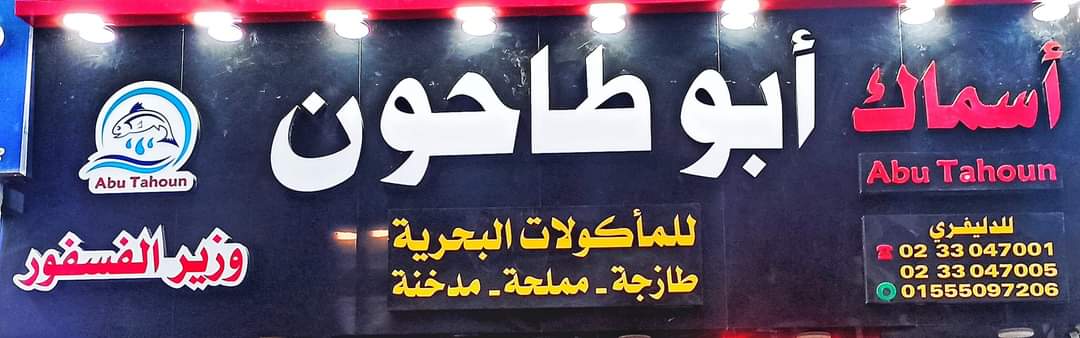
“Abu Tahoun”.. From Desouk to Sudan Street: A Tale of Feseekh That Began as a Gift to the King and Became an Unmatched Brand
Cairo – Mostafa El Masry:
In the heart of Mohandessin, along the ever-busy Sudan Street where daily stories intersect with the rhythm of fast-paced city life, the name Abu Tahoun stands out as one of those rare brands built not by advertising, but by decades of trust, craftsmanship, and reputation.
This is not merely a story about feseekh and herring, but about a family legacy that has withstood the test of time and secured a permanent place in the memory of Egyptians.It is more than a shop; it is the story of a family whose roots trace back to Desouk, Kafr El Sheikh Governorate, where reputation is crafted long before the product itself. There, the profession became a heritage passed down through generations, much like great family names.
From that origin, Abu Tahoun made its way to Cairo, preserving the spirit of tradition while embracing a modern mindset that understands the evolving market.Behind the name lies a remarkable tale blending courage with heritage. It begins with a grandfather who chose an unconventional royal gift during the reign of King Farouk—a giant feseekh placed inside a silver box and presented to the royal palace.
What followed was an extraordinary journey of proving quality and authenticity, including official examinations confirming its nutritional value. That moment became the starting point of a name that today carries significant weight among lovers of Egyptian seafood traditions.
With such a long history, one question naturally arises: how did it all begin, and how has Abu Tahoun maintained its standing in a highly competitive market?
“We are not talking about one or two years of business,” the owner explains. “We are speaking of a history that goes back more than a century. I personally hold a commercial registration dating back to 1948, but the business itself is much older than that. Our roots are in Desouk, Kafr El Sheikh, which is considered one of the foundations of this craft. This is not just trade—it is our family name and our history.”One of the most fascinating chapters remains the royal palace story.
How did feseekh make its way there at a time when it was far less known than today?
“At the time, feseekh was not widely recognized. My grandfather wanted to do something different, so he prepared an exceptionally large fish, placed it in a silver box, and delivered it as a gift to King Farouk.
People at the palace did not understand what it was at first, so he was temporarily detained until they verified the matter. Later, a full analysis was conducted, proving that it was nutritious and rich in elements such as iodine, under the supervision of the king’s nutrition physician.
For us, this is not merely a story—it is proof that the craft was always carried out with excellence.”
As markets evolved and competition increased, another challenge emerged: how could a family name be protected in an open and crowded market?
“Abu Tahoun is not just a shop name—it is a family title,” he says. “That is the difference. The name is officially registered, and some tried to use it, but they were stopped because it belongs to its rightful owners. Family members may use it, but outsiders cannot. The name itself is our true capital, even more than the product.”
As public taste developed and demand diversified, the business naturally expanded beyond feseekh and herring into wider seafood offerings.“We have always worked in fish,” he explains. “We own fish farms in Kafr El Sheikh, in Damro, producing tilapia and mullet.
We understand seafood very well. But the idea of opening a full seafood restaurant only came about four or five years ago. We introduced grilled and fried fish alongside feseekh and herring, which greatly expanded our audience.”At the center of this experience stands the Sudan Street branch, considered a defining milestone.“
This is my main branch, which I established in 2016. Sudan Street is a highly dynamic location with students, doctors, workers, and families. The success there came because people experienced the food themselves, not simply through social media.
Word of mouth remains the strongest form of marketing.”Following success in Mohandessin, expansion into new districts soon followed, including Hadayek Al Ahram.“
It was suggested by a friend who believed the area lacked a specialized feseekh destination. We opened there, and thankfully the response was excellent. Once people saw the success, many others entered the same field in the area, which is natural whenever clear success appears.”
With continued expansion, attention turns to future opportunities in densely populated districts such as Faisal.“Faisal is a huge area with great diversity, which can be an advantage for any project.
At the same time, it has strong competition. If we enter, it must be with something distinct and powerful. Success is not about location alone—it is about what you offer inside that location.”Despite competition, demand continues to grow.
What is the secret behind this enduring success?
“The answer is simple: quality and cleanliness. Whoever eats once and feels satisfied will return and bring others. Social media is important, but it is not the foundation. The real foundation is consistency and trust. We have built that for decades, and that is why people come from distant areas specifically to eat here.”
Looking ahead, what are the next expansion plans?
“We are considering branches in Nasr City or New Cairo, as both areas have strong markets and high population density. My current focus remains Cairo and Giza, as they are the center of business. Later, we may think beyond Egypt, but any move such as franchising must be carefully studied, because if done incorrectly, it could damage the name.”
In closing, the philosophy behind Abu Tahoun may be the true reason for its longevity.“We work by one principle: the name is more important than quick profit. You may profit once and lose your name, but if you protect your name, you will profit for a lifetime. This business is not just about food—it is about trust between you and the customer. Once trust is lost, everything else is lost after it.”

